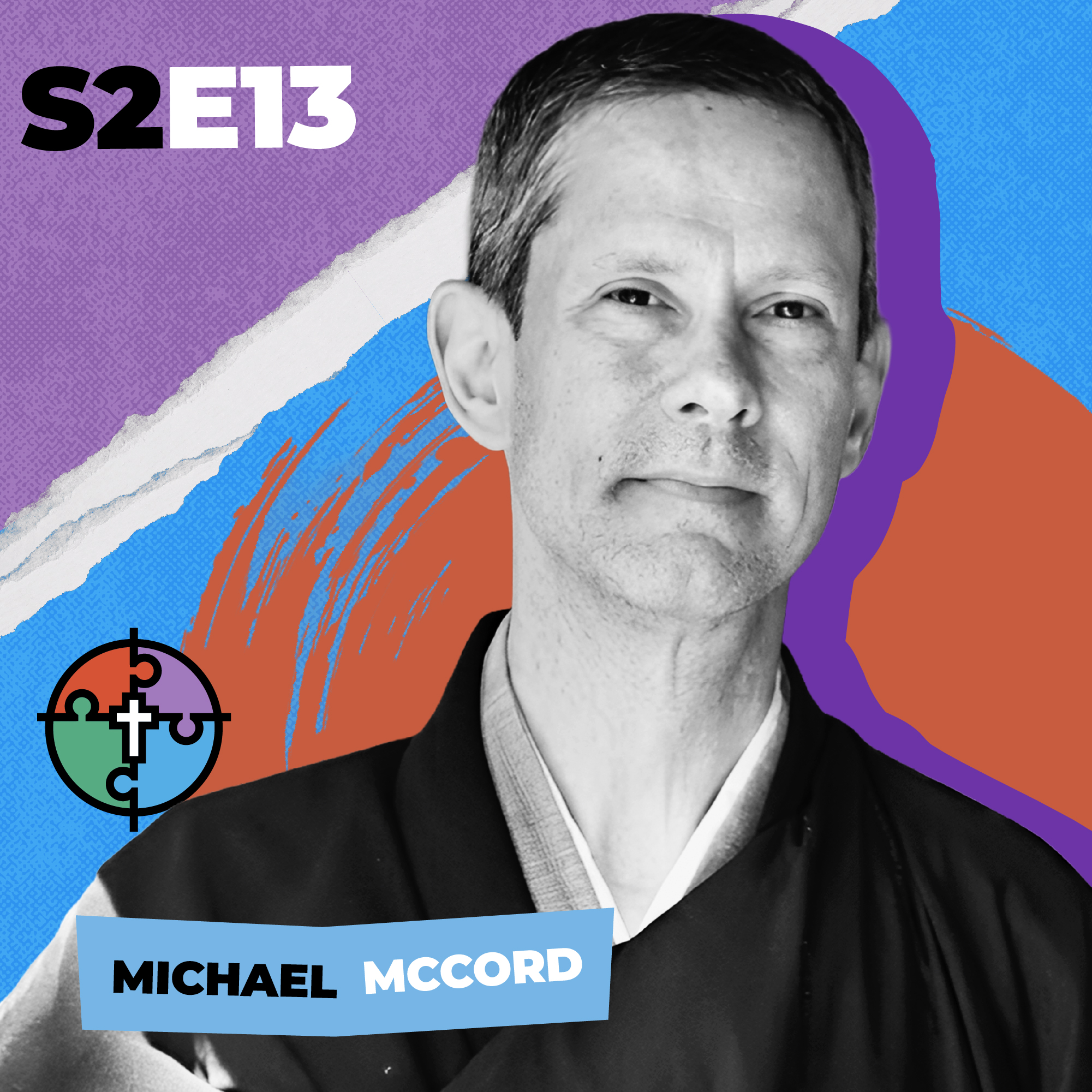
The Bodhisattva Vow with Michael McCord
QUICK SUMMARY
What happens when a former tech and finance professional trades spreadsheets for robes and then brings Zen back into the boardroom? In this rich, wide-ranging conversation, hosts Dave Plisky and Father John Gribowich sit down with Sozan Michael McCord, President of San Francisco Zen Center, to explore what it means to live a 24/7 spiritual practice in the middle of Silicon Valley’s relentless hustle culture. From a crisis of faith in a conservative Christian church, to a fortune teller at a Microsoft company party, to leading a 3,000-member Tuesday night Zen gathering for tech workers in their 20s and 30s, Michael’s story is anything but conventional. And his insights on AI, consciousness, and what makes us irreducibly human might be the most important thing you hear this week.
IN THIS EPISODE, WE EXPLORE
- “Zen is a 24/7 practice — or it’s just a weekend hobby.” How Michael defines Zen for modern life, and why most people are doing it wrong. (00:04:00)
- From evangelical Christianity to a Zen priesthood — Michael’s extraordinary personal journey through faith, doubt, and reinvention. (00:08:00)
- The fortune teller at the Microsoft party who told Michael exactly what path he needed to take and why he ignored her. (00:16:00)
- John finally reveals the origin of the podcast’s name, “Religion to Reality,” tracing it to Eastern Orthodox theologian Alexander Schmemann. (00:50:00)
- Zen vs. other forms of Buddhism — how Soto Zen differs, why Zen priests can marry, and how Buddhism has always adapted to every culture it enters. (00:36:00)
- Buddhism: philosophy or religion? Michael recalls the first thing he ever typed into an AI tool and why he liked the answer. (00:46:00)
- Being Human in the Age of AI — Michael’s workshop and why the bodhisattva vow is something no algorithm will ever arrive at logically. (01:06:00)
- The convergence of Christianity and Zen — on kenosis, Buddha nature, and why mystics across traditions are essentially saying the same thing. (00:52:00)
- Truth with a capital T vs. a small t — a stunning Grand Canyon metaphor for how awareness shapes what we call truth. (01:00:00)
ABOUT MICHAEL MCCORD
Sozan Michael McCord is the President of San Francisco Zen Center, where he has been a resident practitioner since 2009. Over the years he has held leadership roles including Director of City Center (Beginner’s Mind Temple) and Chief Financial Officer. Earlier in his practice he served as Eno (head of the meditation hall) and Tenzo (head cook) at Tassajara Zen Mountain Center, the first Zen training monastery outside of Asia, founded in 1969. Michael was ordained as a Zen priest by Ryushin Paul Haller in 2014. Before Zen, he worked in technology and finance, and holds a BA in Theology from Ambassador University. He also volunteered in Amman, Jordan, providing vocational training for individuals with developmental disabilities.
Reach Michael: michael.mccord@sfzc.org
MEMORABLE QUOTE
“If I saw the answers to all of my problems, they’d probably all be solved. Therefore, the way that I need to live is to hold open the door to things that I might not think are true — because that means the answers probably are something that seem a little weird, or a little strange, or just a little wrong.” — Michael McCord
RESOURCES MENTIONED
- San Francisco Zen Center — sfzc.org | Three Bay Area temples: City Center, Tassajara, and Green Gulch. Retreats, sits, courses, and an online zendo available.
- Young Urban Zen — Tuesday nights at SF Zen Center; 3,000+ members, 100+ attendees weekly. Open to all.
- Tassajara Zen Mountain Center — The first Zen training monastery outside Asia, 13 miles from society, founded 1969.
- Brother David Steindl-Rast — Benedictine monk who co-taught interreligious workshops at Tassajara with Paul Haller on the overlap between mystical traditions.
- Thomas Merton, Zen and the Birds of Appetite — Referenced by Fr. John as a complementary exploration of Christianity and Zen.
- Alexander Schmemann — Eastern Orthodox theologian; source of the podcast’s title, “Religion to Reality.”
- Philip K. Dick, Do Androids Dream of Electric Sheep? (adapted as Blade Runner) — Michael references the “empathy box” as a framework for what AI cannot replicate.
- Stephen Batchelor, Buddhism Without Beliefs — Recommended for those interested in Buddhist principles outside a religious framework.
- Thomas Paine — Quoted by Michael: “The measure of a person’s intellect is the scope of what they can entertain without having to digest it.”
- Religion to Reality Substack — religiontoreality.substack.com | Monthly interfaith gathering, first Wednesday of every month (free, online).
- Show notes & resources — religiontoreality.org